


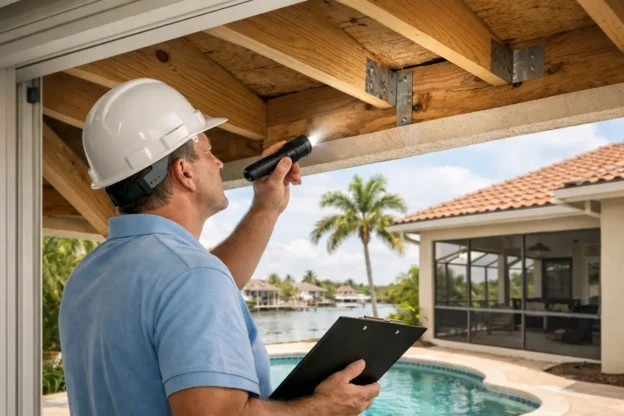
A Fort Myers wind mitigation inspection focuses on one practical question: which wind-resistant features can be documented in your home for insurance purposes? In Southwest Florida, where hurricane exposure is a regular part of property ownership, that documentation can make a meaningful difference when you are shopping for coverage, renewing a policy, or preparing to sell.
This is not a standard home inspection and it is not a prediction of how a home will perform in every storm. It is a focused evaluation of specific construction features that insurers may recognize when determining windstorm premium credits. The quality of the inspection matters because the report must be accurate, supported by visible evidence, and completed in the format the insurance industry expects.
What a Fort Myers Wind Mitigation Inspection Covers
Florida wind mitigation reports typically document five areas of the home: the roof covering, roof deck attachment, roof-to-wall connection, roof shape, secondary water resistance, and opening protection. Each category has its own standards and documentation requirements.
The roof covering refers to the age and condition of the roofing material. A roof that appears to be in good condition may help an insurer evaluate risk, but roof age alone is not the same as a wind mitigation credit. The inspector records information that is visible and supported by available permits, labels, or other documentation when applicable.
Roof deck attachment concerns how the plywood or other roof decking is fastened to the roof framing. Nail size, spacing, and fastening patterns can affect how the roof assembly responds to uplift forces. This information is often observed from accessible attic areas, where the inspector can see the underside of the deck.
The roof-to-wall connection is another major factor. Depending on the home’s construction, this connection may use toe nails, clips, single wraps, double wraps, or other methods. Stronger, properly documented connections may qualify for greater credits than a basic connection. Access matters here. If an area cannot be safely or reasonably observed, it cannot simply be assumed.
Roof geometry examines the shape of the roof. Hip roofs, which slope downward on all sides, may receive favorable consideration because of their wind performance characteristics. A home needs to meet the insurer’s applicable geometry criteria, not merely have a small hip section added to an otherwise gable-style roof.
Secondary water resistance is a barrier installed beneath the roof covering that can help limit water intrusion if shingles, tiles, or other roof materials are damaged during a storm. It cannot always be verified through a visual inspection alone. When the feature is not visible, valid supporting documentation may be needed.
Finally, opening protection addresses windows, exterior doors, garage doors, skylights, and other vulnerable openings. Rated impact products, approved shutters, and certain other protection systems may receive credit when they protect the required openings and are properly documented. Having shutters stored in a garage is different from having a complete, verifiable opening-protection system.
Why Documentation Makes the Difference
A wind mitigation inspection is evidence-driven. Insurers generally need a completed Florida Uniform Mitigation Verification Inspection Form, along with photographs and any relevant supporting records. An inspector must document what is present, not what is likely present based on the home’s age or neighborhood.
That distinction is especially relevant in Fort Myers and nearby coastal communities. Many homes have been reroofed, remodeled, repaired, or fitted with storm protection over time. A home built decades ago may have newer roofing components or upgraded openings, while a newer home may still have features that do not meet the criteria for every available credit.
Permits, invoices, product labels, engineering documents, and manufacturer approvals can help establish qualifying features when the construction is concealed. Homeowners should gather any relevant roofing, window, door, shutter, or garage-door records before the appointment. Documentation does not replace a field inspection, but it can help the inspector accurately record features that cannot be confirmed through ordinary visual access.
A clear report also gives you useful information beyond the immediate insurance conversation. It identifies which features were verified, which were not visible, and where records may be needed. That can be valuable when you are deciding whether a future improvement is worth the cost.
What the Inspection Appointment Usually Looks Like
The process is focused and efficient, but it should never be rushed. The inspector begins with an exterior review of the home, roof configuration, openings, visible storm protection, and garage door. Accessible attic areas are then examined for roof deck attachment and roof-to-wall connection details.
Safety and accessibility set reasonable limits. A steep roof, restricted attic, blocked access point, or concealed construction may prevent confirmation of a feature. In those cases, a dependable report states the limitation plainly rather than filling in gaps with assumptions.
Photo documentation is central to the process. Images may show attic framing, fastening patterns, metal connectors, window labels, shutter systems, garage-door reinforcement, and roof geometry. These photos provide support for the findings and make the report easier for an insurance agent or carrier to review.
At West Coast Home Inspection, the approach is built around careful field documentation and clear communication. Advanced tools, including drone-mounted cameras when conditions support their use, can help document exterior conditions that are difficult to view from the ground. The goal is straightforward: provide a detailed, dependable report that gives the homeowner and insurance professional usable information.
Insurance Savings Depend on the Home and the Carrier
Many property owners schedule a wind mitigation inspection because they have heard it can lower insurance costs. It can, but savings are not automatic and no inspector should promise a specific premium reduction. Your insurer determines eligibility, available credits, policy terms, and the final premium.
The value of an inspection depends on the features found, the carrier’s underwriting guidelines, the age and construction of the home, and the coverage you select. A home with documented roof-to-wall connectors, a qualifying roof shape, and complete opening protection may have more potential for credits than a home with few verifiable wind-resistant features. Even so, the insurer makes the final determination.
For many homeowners, the inspection still makes sense because it replaces uncertainty with a current record of the property’s documented features. It can be helpful when requesting insurance quotes, reviewing a renewal, purchasing a home, or updating a policy after a reroof or opening-protection upgrade.
When to Schedule a Wind Mitigation Inspection
A wind mitigation inspection is commonly scheduled during a home purchase, particularly when the buyer is comparing insurance options before closing. It may also be useful for established homeowners who have never had one completed, whose prior report is outdated, or who have made improvements to the roof, windows, doors, shutters, or garage door.
After a reroof is an especially practical time to consider one. New roofing work may involve upgrades to deck attachment or secondary water resistance, but those features need proper verification and documentation. Likewise, replacing a few windows may improve the home, yet it may not qualify the entire structure for opening-protection credits. The details matter.
Sellers can benefit as well. A current report may provide useful information to prospective buyers who are evaluating insurance costs in a demanding Florida market. It does not replace a buyer’s own due diligence, but it can make the property’s documented features easier to understand.
Preparing for the Best Possible Report
Before the appointment, make attic access available if possible and move stored items away from the access opening. Gather permits, paid invoices, product approvals, and warranty documents related to roofing or storm-protection upgrades. If shutters are present, identify where they are stored and make installation hardware available for review.
It also helps to remember what the report can and cannot do. It documents observable and supportable wind mitigation features for insurance review. It does not certify that a home is stormproof, guarantee insurance coverage, or replace a comprehensive assessment of the property’s condition.
A well-documented wind mitigation inspection gives you a clearer picture of the home you own or plan to buy. When insurance decisions depend on details hidden in an attic, built into a roof system, or attached to an opening, careful verification is a practical form of protection.